
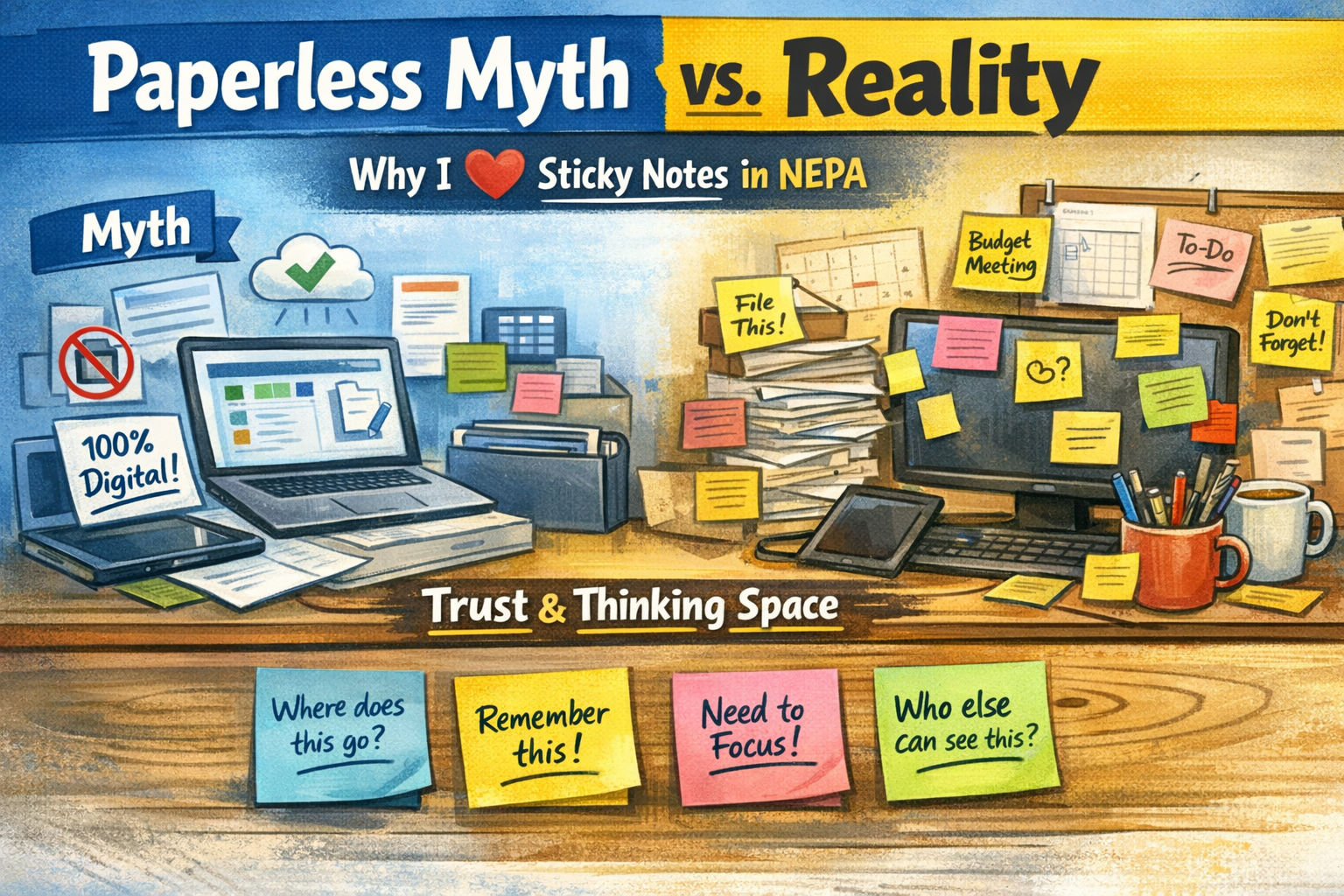
Let’s be honest.
In theory, we’re all paperless.
In practice?
Sticky notes still run a surprising amount of business and nonprofit life in NEPA.
They’re on monitors.
On binders.
On desks.
On printers that were “supposed to be retired” three initiatives ago.
And I’m about to say the quiet part out loud:
My unpopular opinion?
I ❤️ sticky notes.
Not because I hate technology.
Not because I’m clinging to the past.
And definitely not because I miss filing cabinets and fax machines.
I love sticky notes because when I need to think—really think—paper still feels safer than most systems.
If that makes you uncomfortable, good. You’re exactly who this article is for.
Sticky Notes Aren’t a Tech Problem — They’re a Trust Solution
People don’t cling to paper because they dislike technology.
They cling to paper because paper:
- doesn’t require a login,
- doesn’t lock them out mid‑thought,
- doesn’t ask “Where should this live?” before the idea is finished,
- and doesn’t raise the quiet question: “Who else can see this?”
Sticky notes reduce friction and remove uncertainty.
And when stakes are high, leaders and teams default to whatever feels least risky—even if it isn’t the most elegant.
That’s not nostalgia.
That’s human behavior under pressure.
Slower Thinking Isn’t Inefficient. It’s Strategic.
Here’s an uncomfortable truth most “paperless” conversations skip:
Slower thinking often produces better decisions.
Handwriting forces processing instead of copying.
It creates just enough pause for meaning to catch up with information.
That’s why paper still shows up during:
- strategy sessions,
- board conversations,
- complex problem‑solving,
- and decisions with real consequences.
Even the most tech‑forward leaders reach for paper when clarity matters.
Not because technology failed —
but because thinking requires space.
Sticky Notes Are Feedback — Not Laziness
Here’s the leadership reframe that changes everything:
Every sticky note is feedback.
It’s your team quietly saying:
- “I didn’t know where this belonged yet.”
- “The system felt heavier than my thought.”
- “I wasn’t confident I’d find this again.”
- “I needed visibility, not storage.”
If leadership hasn’t made information placement obvious, people will create their own systems.
Sticky notes aren’t disobedience.
They’re evidence.
And no “paperless policy” ever fixed a trust gap.
NEPA Reality: Paperless‑ish Works Better Than Paperless
In NEPA, we’re practical.
We don’t want trends.
We want work to work.
So what actually succeeds looks like this:
- Digital tools handle what must be shared, secured, reviewed, and reused.
- Paper handles the messy middle — thinking, sketching, sorting, deciding.
- Sticky notes quietly bridge the gap between idea and action.
That’s not failure.
That’s Almost Paperless — and it’s an intentional leadership decision.
Where Copilot Helped (Without Turning This Into a Sermon)
Copilot didn’t replace my sticky notes.
What it did was make them less fragile.
It helped answer the familiar follow‑up question:
“Now what do I do with this?”
Instead of ideas living forever on paper — or disappearing when the sticky note fell off the monitor — there was a clear, trusted next step.
Good technology doesn’t demand behavior change first.
It earns trust by supporting how people already think.
Office Gossip Edition (Because This Is Still True)
Board member: “We need to go paperless.”
(Prints the agenda from the email.)
CEO: “We need a single source of truth.”
(Everyone silently thinks of the same person.)
Nonprofit director: “We’re too busy to change systems.”
(Spends 20 minutes hunting for a file.)
Sticky notes don’t create these problems.
They reveal them.
The Real Question Leaders Should Ask
The question isn’t: “How do we finally go paperless?”
It’s: “How do we make digital feel as trustworthy, visible, and natural as paper — without fighting how humans think?”
When that happens:
- sticky notes fade on their own,
- the printer finally rests,
- and paperless stops being a mandate and starts being a byproduct.
And if you’re reading this with a sticky note nearby that says “Go paperless”…
You’re not behind.
You’re paying attention — to how work actually gets done.
If your organization is stuck between “we should” and “we actually do,” you’re not alone — and you don’t need to burn the office supply closet to move forward. Sometimes it starts with mapping what people already trust, and building from there.