
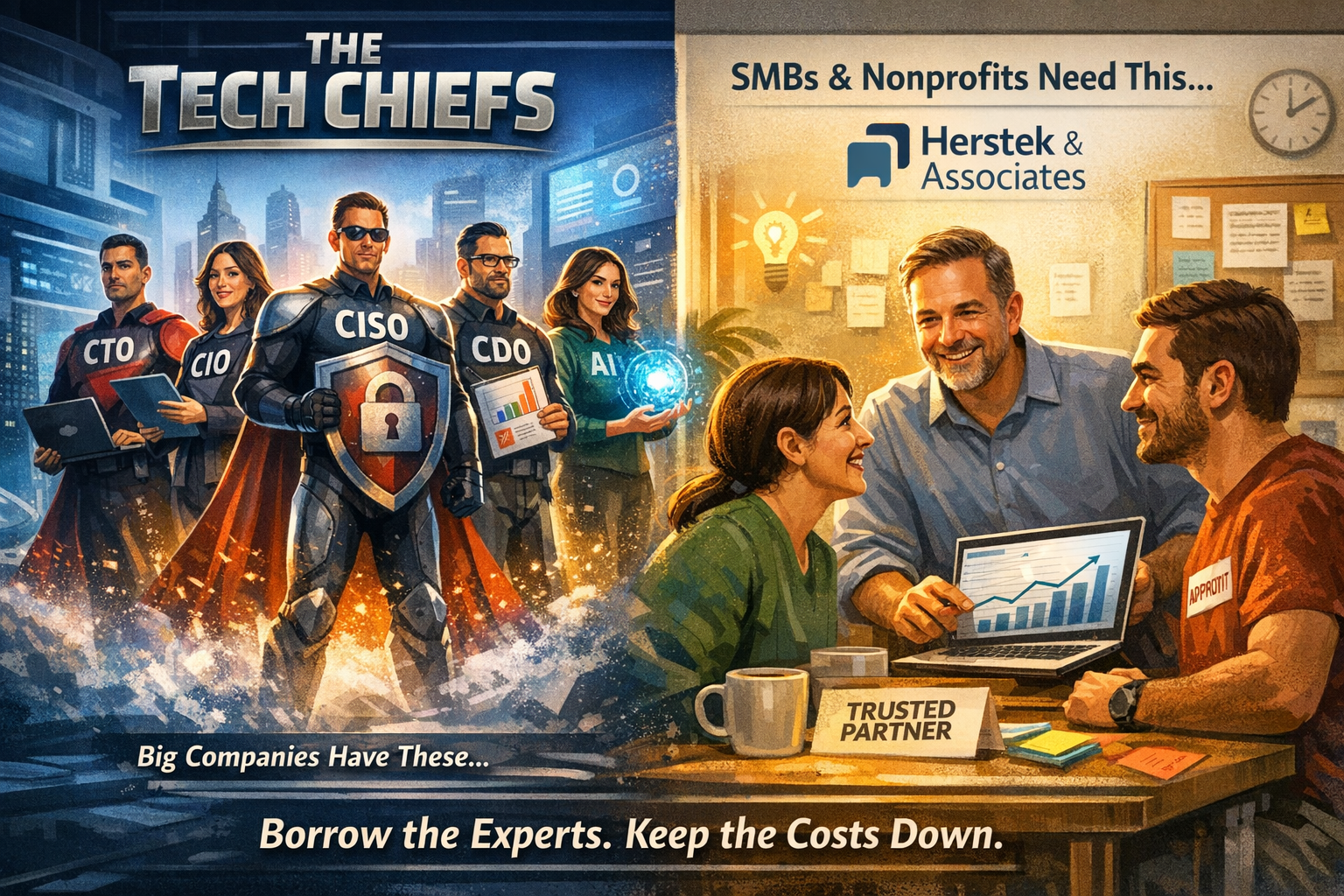
(Small Businesses Don’t Have to Go Without One)
If you’ve ever looked at a Fortune 500 org chart, you’ve probably wondered:
Why do they need that many Chiefs?
Chief Technology Officer.
Chief Information Officer.
Chief Information Security Officer.
Chief Data Officer.
Chief AI Officer.
At this point, it feels less like leadership and more like assembling The Avengers of Technology Oversight.
If you lead a small business or nonprofit, this probably feels like a world you were never invited into.
And maybe even a little unnecessary.
But here’s the part worth paying attention to:
Those titles aren’t about size. They’re about coverage.
What All Those “Chiefs” Actually Do (Without the MBA Language)
Big organizations don’t hire Chiefs because they love expensive job titles. They hire them because each one is watching a different risk, decision, or opportunity — so leadership doesn’t have to guess.
In plain English:
- CTO – Is our technology moving the business forward… or quietly getting in the way?
- CIO – Does our tech actually support how people work day to day?
- CISO – What could go wrong, and how bad would it be if it did?
- CDO – Do we trust our data — or are we just hoping it’s right?
- CAIO – Who’s using AI, how, and are we comfortable with that?
Different titles.
Same mission:
Reduce surprise.
None of these roles exist to install software or reset passwords.
They exist to think ahead — especially when no one else has time to.
The Real Gap for SMBs and Nonprofits
Small organizations don’t lack intelligence, effort, or care.
They lack bandwidth.
Technology decisions often land with:
- The owner
- The executive director
- The office manager who’s “good with computers”
- Or whoever complained the loudest
That’s not reckless. It’s human.
Most technology decisions aren’t made in meetings —
they’re made between inbox alerts, during lunch, or five minutes before something else explodes.
Big companies design roles to catch issues early.
Smaller ones usually feel them later.
You Don’t Need Five Chiefs — You Need the Perspective
SMBs and nonprofits don’t need enterprise org charts.
You don’t need five salaries or weekly strategy meetings with color‑coded dashboards.
What you need is the thinking behind those roles — without the overhead.
That’s where the difference between a vendor and a trusted partner becomes very clear.
Vendor vs. Partner (There Is a Difference)
A vendor asks:
“What tool do you want?”
A partner asks:
“Why does this matter — and what happens if it doesn’t work the way you expect?”
A vendor reacts.
A partner observes, questions, and connects dots across security, operations, people, and risk — the same way those Chiefs do in larger organizations.
That isn’t about control.
It’s about context.
Borrowing the Chiefs — Without Paying Their Salaries
Working with a trusted firm like Herstek & Associates gives SMBs and nonprofits something very familiar to large organizations:
- Someone watching technology decisions before they quietly go sideways
- Someone thinking about trust, privacy, and risk before staff experiments on their own
- Someone translating fast‑moving tech changes into calm, human business language
Not panic.
Not pressure.
Just thoughtful conversation before decisions stick.
That’s not outsourcing responsibility.
That’s sharing perspective.
Why This Matters Right Now
Technology rarely arrives with a rollout plan and a ribbon‑cutting ceremony anymore.
It sneaks in through:
- Browser tabs
- Free trials
- Helpful “just testing this” tools
- AI features no one remembers approving
Big organizations expect this — which is why they hire people to watch for it.
By the time something breaks, the decision has already been made.
The Bottom Line
Large companies don’t have more Chiefs because they’re smarter.
They have them because they’ve learned — usually the hard way — that unchecked technology decisions always cost more later.
SMBs and nonprofits don’t need to become enterprises.
They just need someone standing slightly ahead of the curve, watching what’s coming, and thinking about the whole picture.
That’s the role of a trusted partner.
And it’s exactly where Herstek & Associates fits — not over your shoulder, but alongside your business.
One last thought:
If large organizations refuse to operate without multiple technology leaders, the real question isn’t “Can we afford that perspective?”
It’s what happens when no one has it?