
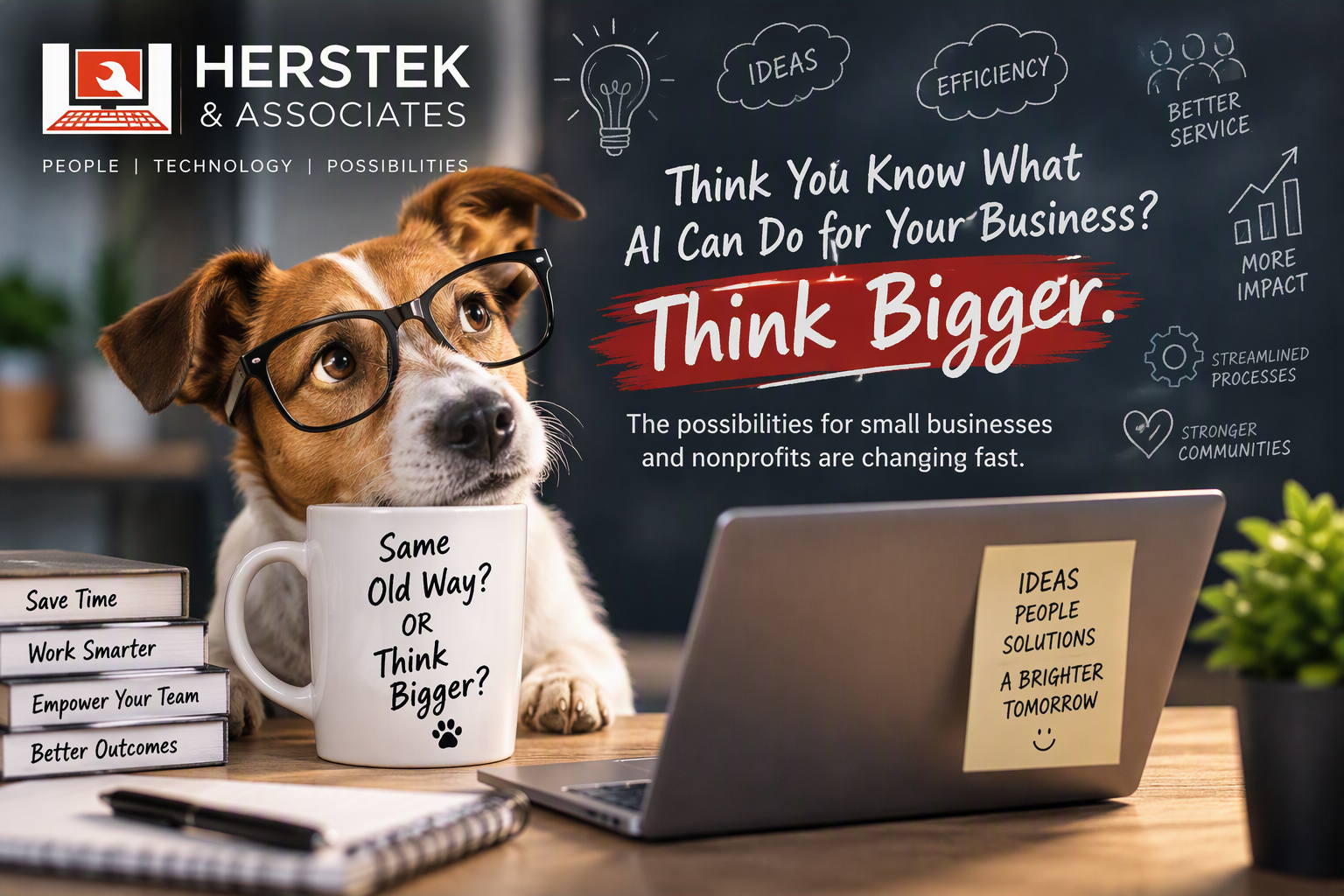
The possibilities for small businesses and nonprofits are changing fast.
When most small-business owners hear “AI,” they probably think of a chatbot.
Write an email.
Summarize a document.
Create a social media post.
Help with a spreadsheet.
Maybe ask it why Excel has suddenly decided your phone numbers are dates.
Useful? Absolutely.
But that’s barely scratching the surface.
The more interesting question isn’t:
“What can I ask AI?”
It’s:
“What could AI actually do inside my organization?”
And that’s where things start getting interesting.
Think Bigger
Imagine having an AI assistant that understands your organization’s procedures and can help employees find answers to questions.
Or one that helps a new employee learn how your organization actually operates.
Imagine turning years of scattered knowledge into information your team can more easily find, understand and use.
Think about an AI assistant that could help organize incoming information, summarize it, and identify what actually needs someone’s attention.
Or help compare vendors.
Prepare for meetings.
Analyze documents.
Research a decision from multiple perspectives.
Find information buried somewhere in the digital Bermuda Triangle otherwise known as:
“the shared drive.”
Now think even bigger.
Different areas of an organization could potentially have different AI capabilities.
Management might need something entirely different from accounting.
Your administrative staff may need help managing repetitive workflows.
Your employees might need a way to find information without searching through 37 folders, six emails and a spreadsheet called:
FINAL-FINAL-USE-THIS-ONE-v4.xlsx
Some processes might even happen automatically in the background, while people remain responsible for the decisions that actually require human judgment.
At that point, we aren’t really talking about using a chatbot anymore.
We’re talking about designing technology around how your organization actually works.
And that’s a much bigger conversation.
What Would You Change About Your Business If You Could?
This may be the better place to start.
Forget AI for a minute.
Look around your organization.
What frustrates everyone?
What do people do over and over again?
What takes 30 minutes that feels like it should take five?
What information can nobody ever find?
What process depends entirely on one employee knowing how to do it?
What happens when that employee goes on vacation?
What information gets entered in one place, then entered again somewhere else?
Where are employees spending time managing the work instead of doing the work?
And what have you caught yourself saying:
“I wish our software could just…”
Finish that sentence.
Because increasingly, some of those frustrations are becoming interesting candidates for AI, automation and smarter technology.
Not every one.
But probably more than most small businesses realize.
Small Businesses and Nonprofits Shouldn’t Have to Sit This One Out
This is the part we’re especially excited about.
For years, sophisticated technology often meant sophisticated budgets.
Custom software.
Developers.
Large IT departments.
Consultants.
Projects that simply didn’t make sense for a 10-person company or a local nonprofit.
That’s changing.
The neighborhood accounting firm.
The contractor.
The manufacturer.
The law office.
The family business operating in Northeastern Pennsylvania for 40 years.
The nonprofit trying to accomplish a huge mission with six employees, three volunteers and approximately nine dollars left in the technology budget.
These organizations have something incredibly valuable:
They know how their organization works.
They’ve accumulated procedures, processes, documents, experience and institutional knowledge over years or even decades.
The problem is that knowledge is usually scattered.
It’s in documents.
It’s in email.
It’s inside software.
It’s in filing systems.
It’s in someone’s notebook.
It’s on a server.
And some very important part of it is inevitably stored exclusively inside someone’s head.
AI opens up fascinating possibilities for making that knowledge more accessible and useful.
But there’s another side of this conversation that’s just as important.
Just Because AI Can Do Something Doesn’t Mean It Should
We’re technologists.
So naturally, we’re excited about what’s becoming possible.
We’re also professional worriers.
Security matters.
Privacy matters.
Permissions matter.
Accuracy matters.
Your data matters.
Understanding where your organization’s information is going matters.
And keeping people involved where human judgment is important really matters.
Sometimes the smartest AI strategy may be:
“Absolutely not. We’re not giving AI access to that.”
That’s not being anti-AI.
That’s using technology responsibly.
Businesses shouldn’t rush to connect AI to everything simply because they can.
They should understand what they’re trying to accomplish first.
Then determine whether AI is actually the right tool.
Where Herstek Comes In
For more than 30 years, Herstek & Associates, LLC has helped organizations understand technology and figure out how to make it work for them.
AI is becoming the next chapter of that conversation.
And we’re not starting with:
“Which AI product should you buy?”
We’re starting with:
“What could AI help your organization do?”
We’re actively researching and testing emerging AI capabilities and thinking carefully about how they could fit into real small-business and nonprofit environments.
Because our clients don’t need us chasing every shiny new AI announcement.
There will be plenty of those.
They need someone who understands technology, understands their organization, asks the right questions and can help separate:
“That could genuinely make our lives easier.”
from:
“Well…that looked really cool in the demo.”
We think the opportunity starts by looking at the organization itself.
Where are employees losing time?
Which repetitive processes could potentially be improved?
What organizational knowledge could become easier to access?
Where could AI assist employees without replacing human judgment?
What information shouldn’t AI have access to?
What security and privacy questions need to be answered first?
And perhaps most interestingly:
What could we create specifically for the way your organization works?
Because we don’t think the future of small-business AI is going to be one AI product that everyone buys and uses exactly the same way.
Businesses aren’t the same.
Nonprofits aren’t the same.
Their people aren’t the same.
Their processes aren’t the same.
Their technology isn’t the same.
Their risks aren’t the same.
And their problems certainly aren’t the same.
So why would their AI strategy be?
Think Bigger.
Don’t start by asking:
“Should our organization use AI?”
Ask:
“If we could remove some of the friction from running this organization, what would we change?”
Start there.
Find the bottlenecks.
Find the repetition.
Find the information nobody can find.
Find the process everyone hates.
Find the thing that makes someone say:
“There HAS to be a better way to do this.”
Then let’s find out if there is.
Because small businesses and nonprofits shouldn’t assume the most interesting capabilities in AI are reserved for giant companies with giant technology budgets.
You may be able to do far more than you realize.
You just need to know what’s possible.
And that’s the conversation Herstek & Associates, LLC wants to help organizations start.
Think you know what AI can do for your business?
Think bigger.
Herstek & Associates, LLC
Helping small businesses and nonprofits figure out what’s possible, what’s practical, and what’s actually worth doing.